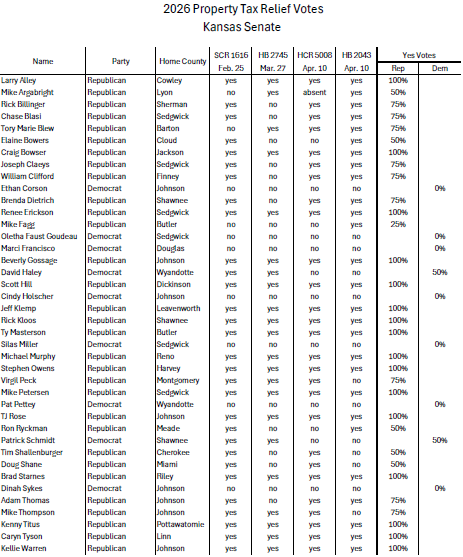
Every Kansas legislator entered the 2026 session professing strong support for property tax relief, but voting records tell a different story for many of them.
Public opinion polling shows that at least 75% of voters want limits on assessed value and mill rate increases, but only 40% of legislators voted for those bills more than 75% of the time. In the Senate, 16 Republicans voted “yes” on each of four votes; in the House (see List 1 and List 2), 49 Republicans voted “yes” on eight of nine votes, and one Democrat – Lynn Melton from Wyandotte County – voted “yes” seven times.
 One House Republican (Kyle McNorton – Shawnee Co.) and seven of the nine Senate Democrats voted “no” on every bill. Another House Republican (Brian Bergkamp – Sedgwick Co.) voted against eight of the nine property tax measures.
The premise of this analysis is that each proposal to restrict increases in assessment limits and mill rates (above revenue-neutral) would have been better for taxpayers than the current situation.
For example, some legislators voted against an assessment limit based on a rolling average of prior valuations because they preferred the superior taxpayer protection of a fixed-rate limit, but, as explained here, the rolling-average methodology is a little better than nothing. Another example is the proposed 9% assessment ratio on residential property, which is the only measure opposed by the 49 House Republicans who voted “yes” eight times out of nine.
Strictly evaluating votes on the basis of taxpayer benefit avoids making judgment calls about legislators’ motivations (did they vote “no” because they want something better, or because they don’t want anything to pass), while still providing a reasonable pattern of representing their constituents’ desires.
Some legislators support property tax relief only if it doesn’t inconvenience local governments
Questions from legislators in committee hearings and comments during floor debates brought sharp focus to what is likely the primary barrier to property tax relief: a growing number of legislators place a higher priority on local governments’ concerns than on their constituents.
 For example, the original House proposal in HB 2745 for a mill rate limit required voter approval for increases above 3%, excluding those from new construction. The bill also granted three local government wishes: eliminate revenue-neutral, exempt school districts from the transparency provisions, and give bonuses to counties that don’t exceed the limit. It was a pretty good deal for cities and counties, but they still wanted more, so the House Tax Committee amended the bill to also exempt tax increases from expiring subsidies and debt payments. Another amendment replaced the public vote with a protest petition because local officials said that preparing for a vote in November, in August, or on a special election date of their choosing was too cumbersome.
Comments from the legislators proposing and voting for those local government enhancements raised multiple concerns about the cities and counties that created our property tax crisis, but little acknowledgement of people being taxed out of their homes.
This year also saw the creation of a 40-member Local Government Caucus by two House Republicans, Rep. Allen Reavis and Rep. Lon Pishny. The stated purpose is to help fellow legislators understand “the unspoken impact state laws and regulations have on city and county governments.” The caucus formalizes what the voting records already suggest: a growing, coordinated effort within the Legislature focused on prioritizing the concerns of local governments over placing firm limits on their taxing authority.
Another year has gone by without a desperately needed assessment limit to protect homeowners from a 40% average valuation increase over the last four years. A watered-down mill rate limit passed that Governor Kelly should sign because it addressed all of her concerns, but the Legislature won’t be able to override if she vetoes it, because they already adjourned for the year to hit the campaign trail.
Take a few minutes to see how your Representative and Senator voted on property tax relief, so you’re prepared if they try to blame property tax failure on someone else when the real culprit is in their mirror.


(editor’s note: this column originally included an inaccurate description of the proposed amendment to SCR 1616).