

Last year, the Kansas Association of Realtors (KAR) lobbied against an assessment limit — a constitutional amendment to cap assessed value increases. As the Sentinel recently reported, many individual realtors supported the amendment — and noted they’d never been asked their opinion. KAR Vice President of Governmental Affairs Mark Tomb did not comment for that story, but he contacted us to explain his position.
Opponent testimony from the Kansas Association of Realtors last year cited several objections, one of which was that the legislation wouldn’t reduce property taxes. Taxes wouldn’t necessarily drop immediately, but data presented at a Special Committee on Taxation hearing last November would save taxpayers a great deal of money over time.
Further, a public opinion survey conducted by SurveyUSA on behalf of the Sentinel’s owner, Kansas Policy Institute, shows 75% of Kansans want a limit on assessed value increases, and only 13% are opposed.

Despite this, Tomb says KAR opposes an assessment limit.
In a phone interview on Jan. 12, 2026, Tomb said that while they do not survey their members on every issue, “we absolutely survey our membership.”
“We have a policy development process that has realtors from across the state, different size communities, different regions and sizes of local boards [which] send their representatives,” Tomb said. “There’s a pretty wide open policy development process, including, you know, we’ve invited the Chair of the Senate Assessment [and] Taxation [Committee], she’s presented on this constitutional amendment to our committee. So … they approve a policy statement as a Government Affairs Committee that also gets voted on by our board, and then also … our … full board of delegates at our annual conference approve our policy statement each year.”
However, when pressed, he demurred on where exactly in the policy statement one can find the basis for KAR’s objection.
“I think there’s issues of tax fairness and equity within property taxes should be collected equitably,” Tomb said. “I’d have to look at the statute or the policy statement in front of me. I don’t have it in front of me right now, so, but there are certainly several, several tenants in there that would cover this particular policy.”
Pressed again to identify the same specific passages, Tomb repeated he “would need to have the policy in front of him.”
Tomb said that while KAR supports property tax reform, it does not believe capping assessments will reduce taxes.
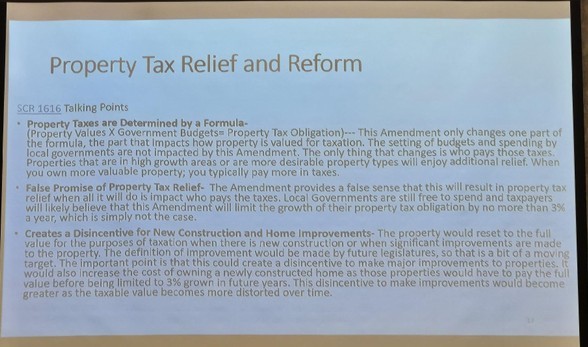
“There’s nothing about this amendment that actually impacts the local government spending side of things,” Tomb said. “This is you take property taxes as a formula, so it’s basically, you know government budgets and you know and then that’s essentially multiplied times you know property and that gives you your property tax obligation. Well, if you’re only dealing with the assessed valuation part of that formula.” Tomb said local governments are still free to raise taxes as much as they wish and “there’s nothing in this legislation that says local government now, all of a sudden, they can’t increase the mill levy. They’re gonna make up their budget and they’re going to be unchecked by … anything other than, I guess, the revenue neutral rate and — eventually — the voters at the ballot box.
KPI CEO Dave Trabert disagrees.
“An assessment limit absolutely would impact government spending decisions. Local elected officials have conditioned voters to equate mill rate increases with tax increases. If they want to continue imposing large tax increases with assessed values limited to 3% growth, they would have to impose significant mill rate hikes risk getting tossed out of office. It’s much more likely that most elected officials curb spending a bit or use some of their carryover cash reserves to avoid a large tax hike.
“Our analysis shows that homeowners could save billions over time, even with mill rate increases that raise local government’s property tax revenue by 4% each year. An assessment limit would make it much harder for local officials to get away with double-digit tax increases, however.”
Tomb has also written that “properties that are in high growth areas or are more desirable property types will enjoy additional relief,” which seems to imply that people with lower-valued homes won’t benefit from an assessment limit.
However, most of the complaints The Sentinel — and our parent company, Kansas Policy Institute — hear about property taxes are from people living on fixed incomes who do not have expensive homes. When pressed for data to show that owners of lower-value homes are not being hit with large valuation increases, Tomb said this was something that “can be clearly handled in the debate with testimony,” and that he didn’t “need to air that out” in an interview.
Tomb also contended that the ballot question was confusing despite the proposed amendment being clear about a limit on assessed valuations and not property tax rates — particularly given that polling showed that only 20% of voters think their appraised values are accurate, and nearly half describe their valuations as “way too high.”
When asked if he thought voters were unable to understand the difference, he said it would take “education.”
“I think it’s gonna take some education,” Tomb said. “I think there would be an assumption on some people’s part, just because property taxes are complex. I think that you’ll see that people will probably, you know, equate, … that their property is going to be capped at 3% they probably are going to assume that their property taxes aren’t going to increase by more than 3% which is not the case. It could increase more than that.
“I’m not calling voters dumb. I think that there’s definitely some education that will need to occur on that. So I think that … definitely we need some education if this were to make it on the ballot.”
When asked about other states — such as Oklahoma, Texas and Florida, which have assessment limits and have significantly lower property taxes — Tomb dismissed it as apples and oranges.
“Well, the assessment limitations in all of those states that you mentioned are quite different,” he said. “So it’s hard to compare apples to truly apples. So when you start comparing states to states, and you can pick and choose, you got to be very careful about, you know what, really is comparable.”